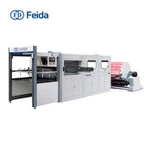
Flexography is a relief printing technology based on the transfer of flexible printing plates and liquid ink. Its core principle involves the synergy of the raised structure of the printing plate, the quantitative transfer of ink, and the pressure transfer. The following is an analysis from three aspects: technical principle, key system, and printing process.
I. Technical principle: synergy of flexible relief and ink transfer
1. Printing plate image structure and ink adsorption
Flexible printing plate: Made of photosensitive resin or rubber material, the image part is raised (thickness 1-5mm), and the non-image part is 0.3-0.5mm lower than the printing plate base. The raised image is formed by laser engraving or exposure and development, with a surface roughness of Ra=0.8-1.2μm, which enhances the ink adsorption.
Ink bearing: The raised image area absorbs ink through capillary action, and the ink layer thickness is about 8-12 μm (controlled by the anilox roller). The non-image area cannot contact the ink because it is lower than the base surface, realizing the precise separation of the image and blank area.
2. Anilox roller quantitative ink supply system
Structural composition: The surface of the anilox roller is distributed with honeycomb cells (opening angle 90°-110°, depth 15-35 μm), which are formed by laser engraving or mechanical etching, and the cell density can reach 600-2000 lines per inch (LPI).
Ink supply mechanism:
Inking: The ink is transferred from the ink tank to the surface of the anilox roller, and the excess ink is scraped off by a scraper (steel or ceramic), leaving only the ink in the cells.
Metering: The cell volume (BCM value, i.e., ink capacity per square inch) determines the ink supply, and the typical value is 1.5-4.0 BCM.
Transfer: The anilox roller contacts the plate cylinder (pressure 0.1-0.3 MPa) and transfers the ink quantitatively to the raised part of the plate image.
3. Pressure transfer and contact with substrate
Printing pressure control: The gap between the plate cylinder and the impression cylinder is adjusted by a pneumatic or hydraulic system (pressure 0.2-0.5 MPa) to ensure that the raised image and text are in full contact with the substrate.
Ink transfer:
Film material: The printing pressure must be accurate to 0.25±0.05 MPa to avoid excessive ink penetration and dot enlargement.
Paper material: The pressure can be appropriately increased to 0.35±0.05 MPa to enhance ink adhesion.
Drying and curing:
Water-based ink: Water evaporation is achieved through hot air drying (temperature 60-80℃) or infrared drying (wavelength 850-950nm).
UV ink: Cured using a UV-LED light source (wavelength 365-395nm), curing time <0.1 second.
2. Key system synergy
System module Core components Technical parameters Synergy logic
Ink supply system Ink tank, anilox roller, doctor blade Anilox roller line count 600-2000 LPI, BCM value 1.5-4.0. Anilox roller line count and BCM value match printing accuracy requirements (high line count corresponds to fine dots, low BCM value reduces ink layer thickness).
Plate system: flexible plate, plate cylinder Plate hardness 30-70 Shore A, thickness 1-5 mm Plate hardness affects dot reproduction (a hard plate is suitable for fine lines, and a soft plate is suitable for rough substrates).
Pressure system impression roller, pneumatic/hydraulic adjustment device Printing pressure 0.1-0.5 MPa Pressure needs to balance ink transfer rate and substrate deformation (film material pressure < 0.3 MPa, paper material pressure > 0.3 MPa).
Drying system: hot air/infrared drying device, UV curing unit UV curing energy 60-120 mJ/cm² Drying efficiency needs to match the printing speed (water-based ink drying time <2 seconds, UV ink curing time <0.1 seconds).
III. Printing process and parameter control
1. Printing process
Printing plate installation: fit the engraved flexible printing plate to the printing plate cylinder (plate mounting accuracy ±0.05mm).
Ink supply debugging: Adjust the pressure of the ink scraper to 0.2-0.3 MPa to ensure uniform ink on the surface of the anilox roller.
Pressure calibration: monitor the gap between the printing plate and the impression cylinder through the pressure sensor, and the error is controlled within ±0.02mm.
Color registration control: use photoelectric eyes to track the color mark and automatically adjust the phase of each color group (registration accuracy ±0.08mm).
Speed matching: printing speed and drying efficiency are coordinated (water-based ink printing speed ≤150 m/min, UV ink printing speed ≤300 m/min).
2. Key parameter control
Dot enlargement rate: coordinated control through printing plate hardness, pressure, and ink viscosity, typical value <15%.
Solid density: solid density of water-based ink is 1.3-1.5 (CMYK), and solid density of UV ink is 1.6-1.8.
Ink viscosity: water-based ink viscosity is 30-50 seconds (Zahn No. 2 cup), and UV ink viscosity is 12-18 seconds (DIN No. 4 cup).
IV. Technical advantages and typical applications
1. Technical advantages
Material compatibility: can print paper, plastic film (PE/PP/PET), aluminum foil, stickers, etc., with a thickness range of 0.01-10mm.
Environmental protection: VOC emissions of water-based inks are less than 5%, and VOC emissions of UV inks are less than 1%, which complies with the EU RoHS directive.
Efficiency and cost: The printing speed can reach 400 m/min, and the plate-making cost is 40% lower than that of gravure printing, which is suitable for medium- and long-run orders (printing volume 5,000-500,000 prints).
2. Typical applications
Soft packaging: food bags (such as potato chip bags and candy films) and daily chemical packaging (such as shampoo films) account for more than 60%.
Corrugated boxes: The pre-printing process achieves 175 LPI high-precision printing, replacing traditional offset pre-printing.
Label printing: self-adhesive labels, in-mold labels, support in-line hot stamping, cold foil transfer, and other processes.
Summary
Flexographic printing achieves high-precision, high-efficiency, and low-cost printing effects through the synergy of flexible printing plates, an anilox roller ink supply system, and pressure transfer. Its core advantages lie in its wide material adaptability, strong environmental performance, and strong in-line processing capabilities, and it occupies a dominant position in the field of packaging printing. With the advancement of technologies such as UV LED curing, water-based ink technology, and closed-loop color control, flexographic printing is accelerating its penetration into market segments such as building materials, decorative films, textile transfer printing, and environmentally friendly paper bags, becoming one of the core technologies to promote the green transformation of the printing industry.