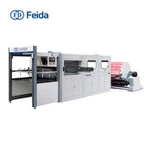
There are significant differences between rotary printing and flexographic printing in many aspects. The following is a detailed comparison of the two.
1. Printing method and principle
Rotary printing
Printing method: Rotary printing is adopted, that is, the printing plate (a cylindrical screen similar to a copper plate) rotates with the roller, and the ink is transferred from the groove to the printing material.
Printing principle: The ink is evenly applied during the rotation of the roller and transferred to the substrate through the pattern and text on the printing plate.
Flexographic printing
Printing method: Flat printing is adopted, that is, the soft printing plate (flexible plate) is in direct contact with the substrate to transfer ink.
Printing principle: Liquid ink or UV ink is applied to the flexible plate. When the plate contacts the substrate, the ink is transferred to the substrate under the action of pressure.
2. Applicable materials and fields
Rotary printing
Applicable materials: Mainly used for printing heavy materials such as cartons and paper bags.
Application field: Widely used in printing packaging, magazines, catalogs and other printed materials with large demand.
Flexographic printing
Applicable materials: Especially suitable for printing of thin materials such as paper and plastic film, such as books, albums, packaging, labels, cartons, etc.
Application areas: It has significant advantages in the field of packaging and label printing, and has gradually expanded to more industries.
3. Printing effects and characteristics
Rotary printing
Printing effect: high printing precision, bright colors, distinct color levels, and stable quality of printed products.
Features: The plate making cost is relatively high, but the printing speed is fast. It can complete the printing of multiple colors in one printing process, and can use a variety of inks, coatings and coatings for printing to achieve different printing effects.
Flexographic printing
Printing effect: It can present delicate and rich colors and images, and the printing quality is high.
Features: Strong adaptability, can print substrates of various materials and shapes; high production efficiency, low cost, environmental protection; with the continuous advancement of technology, the level of digitalization and intelligence continues to improve.
4. Plate making and cost
Rotary printing
Plate making: The plate making cost is relatively high, but it can reduce production costs in long-term large-scale production.
Cost: Due to the fast printing speed, high quality, and the use of less ink and materials for printing, it has good cost-effectiveness in long-term production.
Flexographic printing
Plate making: The cost of plate making is relatively low, and with the continuous advancement of technology, the efficiency of plate making is also constantly improving.
Cost: Due to high production efficiency and high ink utilization, it has good cost-effectiveness.
Rotary printing and flexographic printing have significant differences in printing methods and principles, applicable materials and fields, printing effects and characteristics, plate making and costs. When choosing a printing method, it is necessary to comprehensively consider factors such as specific printing needs, material characteristics and cost budget.