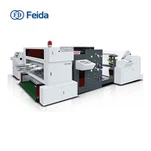
A flexographic printing press is a printing device that uses a flexible plate (also called a rubber plate or photosensitive resin plate) as a printing plate. It is a type of relief printing, but it is significantly different from traditional relief printing in terms of plate material, ink system, and application field. It transfers ink to the surface of paper, plastic film, metal foil, corrugated cardboard, and other materials by directly contacting the image part (raised) on the flexible plate with the substrate, achieving efficient and high-quality printing. The following is an introduction to its core principle, structural composition, technical characteristics, and application fields:
1. Core working principle
Printing plate structure: The flexible plate is made of elastic material (such as rubber or photosensitive resin), with the image part raised and the blank part sunken. The printing plate is fixed on the plate cylinder and contacts the substrate as the cylinder rotates.
Ink transfer: The ink is quantitatively transferred through the anilox roller. The surface of the anilox roller is covered with tiny recesses (net holes), and the amount of ink is controlled by the ink scraper to ensure that the image area is evenly inked.
Pressure control: Gentle pressure (less pressure than offset or gravure) is applied between the plate cylinder and the impression cylinder to transfer the ink from the raised part of the plate to the surface of the substrate.
2. Equipment structure composition
Flexographic printing machines are usually composed of the following modules:
Unwinding unit: used for continuous feeding of substrates (such as webs and plastic films).
Printing unit: includes plate cylinder, anilox roller, impression cylinder, and doctor blade, supporting multi-color overprinting (commonly 4-10 colors).
Drying/curing system: Infrared (IR), hot air, or ultraviolet (UV) curing devices are configured according to the type of ink to ensure that the ink dries quickly.
Rewinding unit: rewinds the printed substrate into a roll or directly enters the subsequent processing steps (such as die-cutting and laminating).
Control system: adjusts parameters such as tension, registration accuracy, and printing speed (usually 50-300 m/min) through PLC or automation system.
3. Technical features and advantages
Environmental protection:
Use water-based, solvent-based, or UV inks, among which water-based inks have extremely low VOC (volatile organic compound) emissions and comply with environmental regulations.
The printing plate can be reused to reduce waste.
High efficiency:
The printing speed can reach more than 300 meters per minute, which is suitable for mass production.
One-stop completion of multi-color printing, glazing, lamination, and other processes to shorten the production cycle.
Wide material adaptability:
Can print a variety of materials with a thickness of 0.01-10mm, including films (such as PE, PP, and PET), paper, metal foil, non-woven fabrics, etc.
Especially good at printing corrugated cardboard (pre-printing process), avoiding the damage of traditional offset printing to the corrugated structure.
Low cost:
The plate-making cost is lower than that of gravure printing, and the plate-changing speed is fast (10-30 minutes).
Low ink consumption (due to quantitative ink supply of the anilox roller).
4. Application areas
Packaging printing:
Flexible packaging (food bags, daily chemical packaging) accounts for about 60% of the flexographic printing market.
Corrugated box pre-printing: achieve high-precision color pattern printing and increase product added value.
Label printing: suitable for self-adhesive labels, in-mold labels, etc.
Publishing and printing:
Web printing of newspapers and magazines (especially in the European and American markets).
Special printing:
Packaging and printing of sanitary products (sanitary napkins, diapers).
Building materials (wallpaper, floor film), textiles (transfer printing), and other industrial fields.
5. Comparison with other printing technologies
Technology: Flexographic printing Offset printing, gravure printing Digital printing
Plate material Flexible resin plate Metal PS plate Metal engraving plate Printless plate (electronic imaging)
Printing pressure Gentle (elastic plate) Medium (rubber roller pressure) Large (high pressure) No pressure (inkjet)
Ink type Water-based/solvent-based/UV Oil-based/UV Mainly solvent-based Water-based/UV/solvent-based
Starting volume Medium (suitable for batch) High (high plate-making cost) High (expensive plate making) Low (personalized customization)
Printing quality High (150-300 lpi) Very high (above 300 lpi) Very high (fine dots) Medium (depends on equipment accuracy)
Applicable materials Film, paper, corrugated paper, etc. Mainly paper Film, metal, etc. Various media
6. Development trend
Digitalization and intelligence: integrated automatic registration, online detection, and color management system to improve production efficiency and stability.
Green printing: Promote water-based ink and UV LED curing technology to reduce energy consumption and pollution.
High speed and wide format: The equipment speed exceeds 400 meters/minute, and the width is more than 3 meters, meeting industrial-grade needs.
In-line processing: Integrate multiple processes such as printing, die-cutting, and lamination to achieve "one-time molding."
Summary: Flexographic printing machines have become one of the mainstream pieces of equipment in the field of packaging printing due to their environmental protection, high efficiency, and material adaptability, especially suitable for medium- and long-run orders and scenes with high environmental protection requirements. With technological advances, its printing quality and production efficiency continue to improve, and it will play a key role in more market segments (such as smart packaging and degradable material printing) in the future.